
A lot of things have happened since I wrote about Flexi funds in 2025.
Flexi cap funds are open-ended dynamic equity mutual funds that invest across large-cap, mid-cap, and small-cap stocks. By mandate, they must invest at least 65% of their assets in equities, but fund managers have complete freedom to adjust capital allocations across market capitalizations and sectors depending on market conditions.
·
Go-Anywhere
Flexibility: Unlike restricted categories (like
large-cap or mid-cap specific funds), a fund manager can shift portfolios
between established blue-chip companies and high-growth smaller companies to
suit the current economic climate.
·
Diversification: Investors get broad exposure to businesses of all sizes,
reducing the dependency on a single market segment.
·
Wealth
Creation:
Automatic exposure to mid and small caps during bull runs helps generate higher
long-term compounding.
·
Risk
Mitigation: When markets are volatile or
experiencing a downturn, managers can shift allocations toward safer, stable,
large-cap companies
Who Should Invest?
Flexi cap funds are generally suited
for long-term investors (typically 5 to 7+ years) looking for a
"core" equity holding. They carry moderate to high risk and are ideal
for those who want an expert to balance their portfolio dynamically across the market
rather than managing different funds themselves
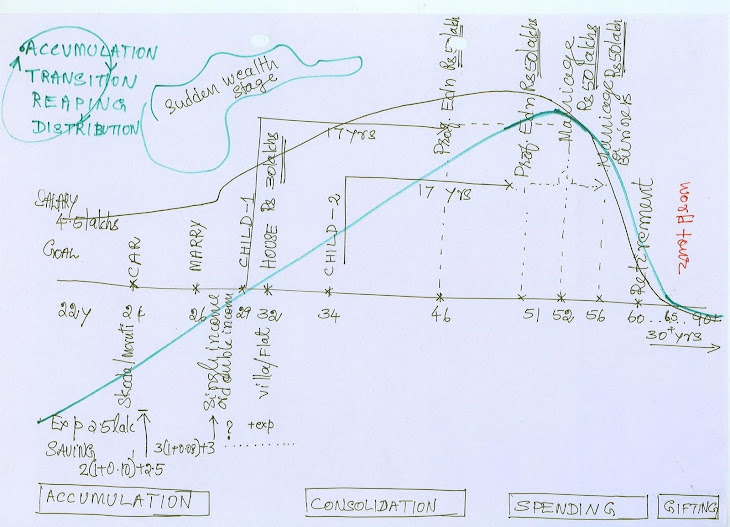
In the words of investment guru Warren Buffet, long term is apprx 20-30 years. That is the zone where future generation will spend money. So make prudential decisions. Sometimes, bearish periods prolong in the market more than we can dip into our pockets. Therefore, no funds for current use or short term use should find its way into these schemes.
Performance
of some Flexi Cap Funds(Regular) 18/06/2026
|
SL
NO |
Scheme |
Exp
Ratio |
Age |
AUM
Rs Cr |
|
1 |
1.05 |
13 |
1,41,447 |
|
|
2 |
1.09 |
31 |
1,01,822 |
|
|
3 |
1.21 |
16 |
54,801 |
|
|
4 |
1.37 |
27 |
26032 |
|
|
5 |
1.40 |
20 |
22,381 |
|
|
6 |
1.40 |
34 |
22, 248 |
|
|
7 |
1.40 |
4 |
21, 189 |
AUM
(Assets Under Management) matters, but its importance varies by scheme type. It
indicates a fund's popularity, liquidity, and cost-efficiency, but it does not
guarantee higher returns
The age of the investment scheme (how long the fund has been operating) and your age (your life stage) are both important, but in different ways
1. Age of the Scheme (Fund History)
·
Proven
Track Record: Funds that have been around longer (e.g.,
5+ or 10+ years) have established a proven track record across multiple market
cycles (bull and bear markets).
·
Consistency
Check: A longer history lets you see how the
fund manager handles volatility and if the fund can consistently beat its
benchmark.
·
Newer
Funds: New schemes aren't necessarily bad, but
they lack a history of how they perform during a market downturn, making their
future performance harder to evaluate.
2.
Your Age (Life Stage)
·
Risk
Appetite: Younger investors generally have a longer
investment horizon and fewer liabilities, allowing them to take on more risk
for higher growth (often by investing in equity funds).
·
Asset
Allocation Rule: A common benchmark for adjusting risk as
you age is the 100 minus
your age rule (e.g., if you are 35, 100 - 35 = 65%
of your portfolio in equities, and the rest in safer debt instruments).
·
Capital Preservation:
As you near retirement or approach your financial goals, the priority typically
shifts from growing wealth to preserving it, meaning you should reduce exposure
to highly volatile schemes
The
expenses charged by an investment scheme—primarily known as the Expense
Ratio—matter significantly in scheme selection. Because these annual
fees are deducted directly from your fund's assets, a higher expense ratio
leaves less of your money invested to grow over time
Direct vs. Regular Plans: You can usually reduce expenses by choosing Direct
Plans instead of Regular Plans. Direct plans bypass distributors and brokers, completely
removing the distribution commissions and lowering the overall fee.
Active vs. Passive Management: Actively managed schemes—where fund managers research and pick
specific assets to beat the market—generally charge higher fees. Passive
schemes, like index funds, require less management and charge much lower fees.
Impact on Compounding: Even seemingly small differences in percentages (e.g., a 0.5%
difference) can compound into significant amounts of money over long-term
investment horizons like 10, 15, or 20 years.
Value for Money: While you should aim for lower fees, the goal is not to blindly
pick the cheapest scheme. It is important to evaluate whether an actively
managed scheme's higher costs are justified by its historical ability to
consistently outperform the market after all fees are deducted
Finally
look at the management based on your philosophy of life, work experience and
gut feeling.
You
may feel like asking so many other questions at this juncture. Too many cooks,
spoil the chicken.
When you are buying from an MFD, it comes with added knowledge and they do the calculations, analysis and find how comfortable are you with processes and procedures and handhold you through untested waters. In fact, each MFD, has their own way of assessing and so the choices may vary from one MFD to another.
Those who read this, also read:

