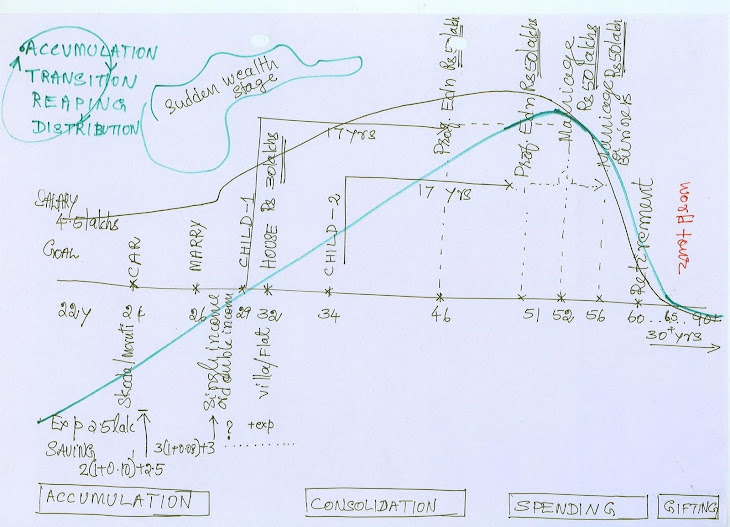
When you get your first pay cheque, is the time to start saving for your Retired Life. The Retirement may be so long like after 35 years or so.. quite long a time frame available for you to save as small as Rs 50 per month. That is how you make the power of compounding work for you.
Trdationally Rent earning real estate like houses or shops rented out or Income earning plantations, the Pension from defined benefit plans and some Gold did the trick for us. Changing labour profile, Size of Population, changing Income avenues all have put pressure on the ways people save for their golden days.
People in Merchant Navy, NRIs etc.. retire as early as 35 years. In this case, the length of retired life may be as big as 45-50 years. The hard earned money is spent on new ventures that quite often blast before gestation period.
With caution and care one has to develop a retirement plan that can help one save regularly and within his means. This must be separated from what you save for starting a business venture / building a house for Primary residence/ Child's marriage/Child's education etc...
What avenues are avialble for you today to save for your retirement that turns in another 30-35 years?
1. The Employees Provident Fund (
Defined Benefit Plan/defined Contribution plan)
2. The
New Pension Scheme (
Defined Contribution plan)
2. Other Opportunities
2.a. Equities
2.b.
Mutual Funds 2.c.
Insuarnce
If Retirement turns in 15 years and above?
1.
Public Provident Fund 2.
Post office Schemes with RD or Reninvestment facilities
3. Rolling
NSC investments
4. Of course all the above roads of first category are open, but more caution required as time frame has reduced.
If Retirement figures up 5 years or less?
1.
Bank Fixed Deposits2.
Company Fixed Deposits /
Debentures3. Debt Mutual Funds
4. Post Office MIPs
5. NSCs
6.
RBI Relief Bonds
7.
Kisan Vikas Patras Definitely you can save through the routes mentioned at both of the above categories are also avilable. Some of them have risk-return profile that leave you in deep trouble. MIP holders felt it in 2001 when many did not get the face value back, if not any return on the investment. Equity holders felt it in 1998, 2001, 2003 and in 2008 when the asset value depreciated heavily.
You will agree that time frame reduction also reduces the eraning capability of these instruments of savings and therefore one needs to save very large amounts to cater to same needs as compared to taht of longer term instruments.
Once you are above 60, you have
Reverse Mortage also an option to fall upon. Reverse mortgage is a financial product that enables senior citizens to mortgage their property with a lender and convert part of the home equity into tax-free income even while retaining the house.
Budget 2008-2009 clarified that reverse mortgage is not "transfer" and the receipts are not income in the hands of Senior Citizens. Section 10(43) exempts any loan received by an individual, whether lumpsum or in instalments, in a transaction of reverse mortgage, if it conforms to the scheme notified by the Central Government. Section 80 E of IT Act 1961 provided exemption of income upto Rs 20,000 w r t Senior Citizens. Here senior Citizens are of age above 65 years for IT purposes.
Another avenue is the
Senior Citizen's Scheme where you can deposit upto 15 lakhs in an account and get annuities
@9%pa.
Once you are retired, how do you go about asset allocation?
Better to be safe with
1/3-1/3-1/3 mode. That is to say that you allocate 1/3 in Dividend yielding Equities, Mutual Funds and managed Portfolios another 1/3 in Fixed Income Earning Debt Mutual Funds and other flexible earning debt assets and remaining in fixed earning Fixed assets. Depending on where you stand in the age profile and your own risk -disposition and personal income needs these ratios will change suitably.
But the most crucial thing in a Retirement Planning is to decide how much money is required at the time of retirement to keep you going say for next 30-35 years.
1.
Annual Replacement Income50% of your Income at Retirement is considered to be adequate to cover the retired annual expenses. So create a fund that has present value of annuity stream of 50% of Retirement age Income net of personal expenses and taxes.
2.
Need Based ApproachProject the
Retirement Income /Expense Needs based on
Inflation rate (3.5% to 4% is considered good )
Tax rate, both current and future
Retirement age
Expected return on investments
Replacement ratio (as above)
Life expectancy
Health conditions (requirement for long term care, personal assistant etc..)
Once the size of fund to be available at Retirement to keep you going for next 30-35 years is known, you have to work out a plan that is suitable for you given the length of work life. It will detail what instruments to save in, at what frequency , in what amounts and from what kind of issuers.
Another route available is to use Provisions of The Maintenance and Welfare of Parents and Senior Citizens Act,2007. You can approach the Tribunal in your State through the
District Welfare Officer not necessarily through an Advocate.
Maximum Rs 10,000 pm can be obtained from the unwilling children! But will you have the energies to fight during these golden days?
Better to start early and take professional help here because it is intermingled with Asset Procurement planning, Tax planning and Protection planning