Recently the US Govt. redeemed $900 billion bonds by infusing fresh money into the system. Now they are operating the way the MARXIST economic policy which they rejected during the cold war days. As protectionism grow in more and more economies, it is time for sitting up drawing a proper financial planning exercise. Japanese savings rate has deteriorated. There are news that Ireland is issuing Govt bonds... All these monies will cause sudden spurt and price rises finally catching up with the consumer.
Though nobody want another October 2008 situation to happen in India, the bursting of govt or private payment capacities affect us wherever it happens in the globe.
The highly volatile stock market frightens the timid and causes panic preventing long term savings. today hardly 1.4% of Household Savings in GDP reach the capital markets. Though the Indian's savings rate has been growing in Financial assets, it has not grown enough. But the way capital markets turns out to be there are no safe heavens any more for investors. The bold takes long term positions in the equity markets and earmark them for retirement planning at early stages of employment.
So PIIGS (Portugal, Italy, Ireland, Greece, Spain) are on rampage.
Take care
Start Early, Proceed Systematically, Look Long Term
Let Your Money Work For You

All You Wanted to know about money
Showing posts with label Retirement Planning. Show all posts
Showing posts with label Retirement Planning. Show all posts
Monday, November 22, 2010


Thursday, October 14, 2010
Retirement Planning: How prepared are you?
Take a test.
Answer the following:
If your anwer at step No: 10 is less than your Net Assets, be alert and find ways to accelerate growth.
Those who just started to have their first job, there is a great opportunity in waiting.
Those who have mid career needs to re-work the chemistry of life
Those who are nearing retirement needs to find protective investments that will sustain them through the empty nest stage.
The New Pension Scheme offers a lot of opportunities for the first two. There are start-up issues in the NPS, though.The DTC will come as a surprise on you, if you do not plan your investments through the life stages Balyam, Kaumaram, Yauvanam, Vardhakyam and Vanaprastham, leaving the impact painful in the middle and unmanageable in the last two stages.
The last but not the least class, has several fixed income options available today.
Senior Citizen Savings Scheme (SCSS) is a fixed-income product that offers 9 per cent return per annum compounded quarterly. It matures after five years and can be extended by another three years. It, however, comes with a couple of riders: an individual cannot invest more than Rs 15 lakh in it and the investor needs to be at least 60 years old at the time of investment. POMIS or fixed deposits of Banks are also there in addition to MIPs from Mutual Funds.
Those who read this also visited:
Answer the following:
- How old are you?
- Name important Life Needs that you want to fulfill during your life time.
- When do you think you will be retiring from active work life?
- How much is your current savings?
- How much will you be able to save every month or quarter or year?
- Allocate savings against your life goals: Never club goals, remember horses for courses
- what is the level of your total assets and liabilities : figure out Net assets
- What is your current income?
- Multiply item 1 and item 8
- Divide by Number 10
If your anwer at step No: 10 is less than your Net Assets, be alert and find ways to accelerate growth.
Those who just started to have their first job, there is a great opportunity in waiting.
Those who have mid career needs to re-work the chemistry of life
Those who are nearing retirement needs to find protective investments that will sustain them through the empty nest stage.
The New Pension Scheme offers a lot of opportunities for the first two. There are start-up issues in the NPS, though.The DTC will come as a surprise on you, if you do not plan your investments through the life stages Balyam, Kaumaram, Yauvanam, Vardhakyam and Vanaprastham, leaving the impact painful in the middle and unmanageable in the last two stages.
The last but not the least class, has several fixed income options available today.
Senior Citizen Savings Scheme (SCSS) is a fixed-income product that offers 9 per cent return per annum compounded quarterly. It matures after five years and can be extended by another three years. It, however, comes with a couple of riders: an individual cannot invest more than Rs 15 lakh in it and the investor needs to be at least 60 years old at the time of investment. POMIS or fixed deposits of Banks are also there in addition to MIPs from Mutual Funds.
Those who read this also visited:
Sunday, January 17, 2010
Asset Allocation By Institutional Investors: Is it any way different?
Quite often, I have wondered why a Mutual Fund scheme is capable of earning better than an insurance scheme or PF and sometimes overwhelmed by the performance of ULIPs over the rest.
To get an idea about earning capacity of the schemes, one needs to know about regulatory requirements binding the earning capacity of each class of them:
1. Mutual Funds
2. Insurance
3. New Pension Scheme(NPS)
4. Non-Govt PF
5. Banks
Mutual Funds can be creative in their portfolio with different objectives for each scheme and thus varying asset allocation. Thus emerges infinite possibilities of risk-return combinations. Beyond that they are limited by single company and single instrument investment norms, mostly guided by governance norms.
But look at insurance companies, they are not permitted to invest their funds freely as the MFs. THE INSURANCE REGULATORY AND DEVELOPMENT AUTHORITY (INVESTMENT) (AMENDMENT) REGULATIONS, 2001 clips the outer limit for these companies as low as 25% Minimum in GOI securities. Unless it is a GOI securities fund, the MFs need not concentrate on them. Thus by birth itself, Insurance schemes have a clipping on their earning capability.
The NPS, the new kid in the street is akin to MF scheme, but with a Management Mandate of distinctive asset allocation according to age and preference of the customer. Pension cannot be managed as a MF scheme mainly because of the difference in the holding period and purpose for which it is invested. Now there are 6 Pension fund Managers to choose from and 3 asset classes of Equity, Corporate Debt & Govt Debt for you choose the required asset combination. The NPS costs in India are the least compared to other countries.
The default plan allocates the investment mix and change according to the age of the subscriber. At the lowest entry age of 18 years, auto choice entails an investment of 50 per cent in E, 30 per cent in C and 20 per cent in G.
The ratios will remain unchanged till the subscriber turns 36, when the ratio of investment in E and C will decrease annually, while the proportion of G rises.
By the time the subscriber is 55 years, G will account for 80 per cent of the corpus, while the share of E and C will fall to 10 per cent each..
It is better to take control yourself at times.
To get an idea about earning capacity of the schemes, one needs to know about regulatory requirements binding the earning capacity of each class of them:
1. Mutual Funds
2. Insurance
3. New Pension Scheme(NPS)
4. Non-Govt PF
5. Banks
Mutual Funds can be creative in their portfolio with different objectives for each scheme and thus varying asset allocation. Thus emerges infinite possibilities of risk-return combinations. Beyond that they are limited by single company and single instrument investment norms, mostly guided by governance norms.
But look at insurance companies, they are not permitted to invest their funds freely as the MFs. THE INSURANCE REGULATORY AND DEVELOPMENT AUTHORITY (INVESTMENT) (AMENDMENT) REGULATIONS, 2001 clips the outer limit for these companies as low as 25% Minimum in GOI securities. Unless it is a GOI securities fund, the MFs need not concentrate on them. Thus by birth itself, Insurance schemes have a clipping on their earning capability.
The NPS, the new kid in the street is akin to MF scheme, but with a Management Mandate of distinctive asset allocation according to age and preference of the customer. Pension cannot be managed as a MF scheme mainly because of the difference in the holding period and purpose for which it is invested. Now there are 6 Pension fund Managers to choose from and 3 asset classes of Equity, Corporate Debt & Govt Debt for you choose the required asset combination. The NPS costs in India are the least compared to other countries.
The default plan allocates the investment mix and change according to the age of the subscriber. At the lowest entry age of 18 years, auto choice entails an investment of 50 per cent in E, 30 per cent in C and 20 per cent in G.
The ratios will remain unchanged till the subscriber turns 36, when the ratio of investment in E and C will decrease annually, while the proportion of G rises.
By the time the subscriber is 55 years, G will account for 80 per cent of the corpus, while the share of E and C will fall to 10 per cent each..
At present, the equity investment, E consists of index funds that replicate the Sensex or Nifty portfolio. The C segment includes liquid funds, corporate debt instruments, fixed deposits and public sector, municipal and infrastructure bonds. The pure fixed investment instruments, G include state and central government securities.
The Non-Govt PF was permitted to invest upto 15% in Equities. The EPF and approved PFs are yet to accept these norms.
The banks are guided by capital to risk weighted asset ratio of 12 per cent. There is a differential risk weighting for different risk class of assets possessed. Under the current standardised methodology of risk weighting, Triple “AAA” to “AA-” rated assets need to be risk weighted at 20 per cent. However, with the credit rating sinking to “A”, the risk weighting increases to 50 per cent. That being the case, banks cannot give you a rate of return on your deposit, beyond a small band.
Thus when the earning capability itself is bounded by Regualatory Requirements, one needs to select the investment that best suits his purpose than just another product.
It is better to take control yourself at times.
Sunday, January 10, 2010
Retirement Planning
When you get your first pay cheque, is the time to start saving for your Retired Life. The Retirement may be so long like after 35 years or so.. quite long a time frame available for you to save as small as Rs 50 per month. That is how you make the power of compounding work for you.
Trdationally Rent earning real estate like houses or shops rented out or Income earning plantations, the Pension from defined benefit plans and some Gold did the trick for us. Changing labour profile, Size of Population, changing Income avenues all have put pressure on the ways people save for their golden days.
People in Merchant Navy, NRIs etc.. retire as early as 35 years. In this case, the length of retired life may be as big as 45-50 years. The hard earned money is spent on new ventures that quite often blast before gestation period.
With caution and care one has to develop a retirement plan that can help one save regularly and within his means. This must be separated from what you save for starting a business venture / building a house for Primary residence/ Child's marriage/Child's education etc...
What avenues are avialble for you today to save for your retirement that turns in another 30-35 years?
1. The Employees Provident Fund (Defined Benefit Plan/defined Contribution plan)
2. The New Pension Scheme (Defined Contribution plan)
2. Other Opportunities
2.a. Equities
2.b. Mutual Funds
2.c. Insuarnce
If Retirement turns in 15 years and above?
1. Public Provident Fund
2. Post office Schemes with RD or Reninvestment facilities
3. Rolling NSC investments
4. Of course all the above roads of first category are open, but more caution required as time frame has reduced.
If Retirement figures up 5 years or less?
1. Bank Fixed Deposits
2. Company Fixed Deposits /Debentures
3. Debt Mutual Funds
4. Post Office MIPs
5. NSCs
6. RBI Relief Bonds
7. Kisan Vikas Patras
Definitely you can save through the routes mentioned at both of the above categories are also avilable. Some of them have risk-return profile that leave you in deep trouble. MIP holders felt it in 2001 when many did not get the face value back, if not any return on the investment. Equity holders felt it in 1998, 2001, 2003 and in 2008 when the asset value depreciated heavily.
You will agree that time frame reduction also reduces the eraning capability of these instruments of savings and therefore one needs to save very large amounts to cater to same needs as compared to taht of longer term instruments.
Once you are above 60, you have Reverse Mortage also an option to fall upon. Reverse mortgage is a financial product that enables senior citizens to mortgage their property with a lender and convert part of the home equity into tax-free income even while retaining the house. Budget 2008-2009 clarified that reverse mortgage is not "transfer" and the receipts are not income in the hands of Senior Citizens. Section 10(43) exempts any loan received by an individual, whether lumpsum or in instalments, in a transaction of reverse mortgage, if it conforms to the scheme notified by the Central Government. Section 80 E of IT Act 1961 provided exemption of income upto Rs 20,000 w r t Senior Citizens. Here senior Citizens are of age above 65 years for IT purposes.
Another avenue is the Senior Citizen's Scheme where you can deposit upto 15 lakhs in an account and get annuities @9%pa.
Once you are retired, how do you go about asset allocation?
Better to be safe with 1/3-1/3-1/3 mode. That is to say that you allocate 1/3 in Dividend yielding Equities, Mutual Funds and managed Portfolios another 1/3 in Fixed Income Earning Debt Mutual Funds and other flexible earning debt assets and remaining in fixed earning Fixed assets. Depending on where you stand in the age profile and your own risk -disposition and personal income needs these ratios will change suitably.
But the most crucial thing in a Retirement Planning is to decide how much money is required at the time of retirement to keep you going say for next 30-35 years.
1. Annual Replacement Income
50% of your Income at Retirement is considered to be adequate to cover the retired annual expenses. So create a fund that has present value of annuity stream of 50% of Retirement age Income net of personal expenses and taxes.
2. Need Based Approach
Project the Retirement Income /Expense Needs based on
Inflation rate (3.5% to 4% is considered good )
Tax rate, both current and future
Retirement age
Expected return on investments
Replacement ratio (as above)
Life expectancy
Health conditions (requirement for long term care, personal assistant etc..)
Once the size of fund to be available at Retirement to keep you going for next 30-35 years is known, you have to work out a plan that is suitable for you given the length of work life. It will detail what instruments to save in, at what frequency , in what amounts and from what kind of issuers.
Another route available is to use Provisions of The Maintenance and Welfare of Parents and Senior Citizens Act,2007. You can approach the Tribunal in your State through the District Welfare Officer not necessarily through an Advocate. Maximum Rs 10,000 pm can be obtained from the unwilling children! But will you have the energies to fight during these golden days?
Better to start early and take professional help here because it is intermingled with Asset Procurement planning, Tax planning and Protection planning
Trdationally Rent earning real estate like houses or shops rented out or Income earning plantations, the Pension from defined benefit plans and some Gold did the trick for us. Changing labour profile, Size of Population, changing Income avenues all have put pressure on the ways people save for their golden days.
People in Merchant Navy, NRIs etc.. retire as early as 35 years. In this case, the length of retired life may be as big as 45-50 years. The hard earned money is spent on new ventures that quite often blast before gestation period.
With caution and care one has to develop a retirement plan that can help one save regularly and within his means. This must be separated from what you save for starting a business venture / building a house for Primary residence/ Child's marriage/Child's education etc...
What avenues are avialble for you today to save for your retirement that turns in another 30-35 years?
1. The Employees Provident Fund (Defined Benefit Plan/defined Contribution plan)
2. The New Pension Scheme (Defined Contribution plan)
2. Other Opportunities
2.a. Equities
2.b. Mutual Funds
2.c. Insuarnce
If Retirement turns in 15 years and above?
1. Public Provident Fund
2. Post office Schemes with RD or Reninvestment facilities
3. Rolling NSC investments
4. Of course all the above roads of first category are open, but more caution required as time frame has reduced.
If Retirement figures up 5 years or less?
1. Bank Fixed Deposits
2. Company Fixed Deposits /Debentures
3. Debt Mutual Funds
4. Post Office MIPs
5. NSCs
6. RBI Relief Bonds
7. Kisan Vikas Patras
Definitely you can save through the routes mentioned at both of the above categories are also avilable. Some of them have risk-return profile that leave you in deep trouble. MIP holders felt it in 2001 when many did not get the face value back, if not any return on the investment. Equity holders felt it in 1998, 2001, 2003 and in 2008 when the asset value depreciated heavily.
You will agree that time frame reduction also reduces the eraning capability of these instruments of savings and therefore one needs to save very large amounts to cater to same needs as compared to taht of longer term instruments.
Once you are above 60, you have Reverse Mortage also an option to fall upon. Reverse mortgage is a financial product that enables senior citizens to mortgage their property with a lender and convert part of the home equity into tax-free income even while retaining the house. Budget 2008-2009 clarified that reverse mortgage is not "transfer" and the receipts are not income in the hands of Senior Citizens. Section 10(43) exempts any loan received by an individual, whether lumpsum or in instalments, in a transaction of reverse mortgage, if it conforms to the scheme notified by the Central Government. Section 80 E of IT Act 1961 provided exemption of income upto Rs 20,000 w r t Senior Citizens. Here senior Citizens are of age above 65 years for IT purposes.
Another avenue is the Senior Citizen's Scheme where you can deposit upto 15 lakhs in an account and get annuities @9%pa.
Once you are retired, how do you go about asset allocation?
Better to be safe with 1/3-1/3-1/3 mode. That is to say that you allocate 1/3 in Dividend yielding Equities, Mutual Funds and managed Portfolios another 1/3 in Fixed Income Earning Debt Mutual Funds and other flexible earning debt assets and remaining in fixed earning Fixed assets. Depending on where you stand in the age profile and your own risk -disposition and personal income needs these ratios will change suitably.
But the most crucial thing in a Retirement Planning is to decide how much money is required at the time of retirement to keep you going say for next 30-35 years.
1. Annual Replacement Income
50% of your Income at Retirement is considered to be adequate to cover the retired annual expenses. So create a fund that has present value of annuity stream of 50% of Retirement age Income net of personal expenses and taxes.
2. Need Based Approach
Project the Retirement Income /Expense Needs based on
Inflation rate (3.5% to 4% is considered good )
Tax rate, both current and future
Retirement age
Expected return on investments
Replacement ratio (as above)
Life expectancy
Health conditions (requirement for long term care, personal assistant etc..)
Once the size of fund to be available at Retirement to keep you going for next 30-35 years is known, you have to work out a plan that is suitable for you given the length of work life. It will detail what instruments to save in, at what frequency , in what amounts and from what kind of issuers.
Another route available is to use Provisions of The Maintenance and Welfare of Parents and Senior Citizens Act,2007. You can approach the Tribunal in your State through the District Welfare Officer not necessarily through an Advocate. Maximum Rs 10,000 pm can be obtained from the unwilling children! But will you have the energies to fight during these golden days?
Better to start early and take professional help here because it is intermingled with Asset Procurement planning, Tax planning and Protection planning
Saturday, June 21, 2008
Wealth Management
Requires Good Financial Planning. It is required for Individual, Proprietory Units, SMEs, Corporates and all kind of legal entities. Human beings may get biased in their thinking process tehreby limiting decision making capabilities.A planned, accepted, monitired and properly led financial plan keeps you floating in all weathers. Portfolio Doctor helps in this regard.
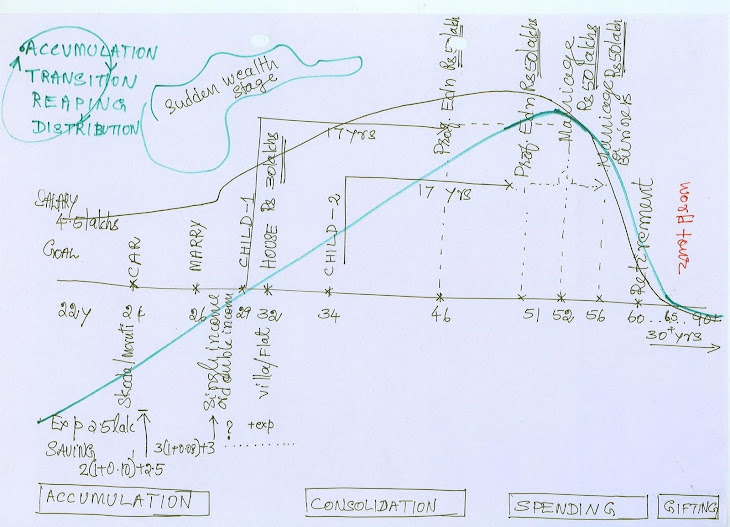
Your income during younger years is less compared to your spending needing active management of your credit lines.
Your income falls sharper in the grey age than your expenses needing active management of retirement income and also creating a corpus to generate that recurring expenses.
As you pass through different life stages, you need a support in planning for healthy financial condition free of personal biases.
Get Assistance from Portfolio Doctor
Your income during younger years is less compared to your spending needing active management of your credit lines.
Your income falls sharper in the grey age than your expenses needing active management of retirement income and also creating a corpus to generate that recurring expenses.
As you pass through different life stages, you need a support in planning for healthy financial condition free of personal biases.
Get Assistance from Portfolio Doctor
Subscribe to:
Posts (Atom)