Debt & Money Market Instrument are prominent not only in the Cash & Savings Management aspects but also in planning for Emergency Funds.
1. Cash Needs : Apart from the recurring expenses at home, one need cash for Asset acquisition and meeting other life needs like Child's Education etc..
We have avenues like Bank Accounts with no frill account, Normal savings Account that have ATM card, Debit card, cheque Books, Internet banking facility etc.. depending upon what balance one maintain with the bank.
The next thing handy is the gold ornaments that you may pledge in a necessity for a short while in the traditional context whereas the modern people use credit cards to tie up short term cash needs.
With developed capital market & terminals available across country, people use MF products like MMMFs, Liquid Funds, FMPs to manage their short term surpluses.
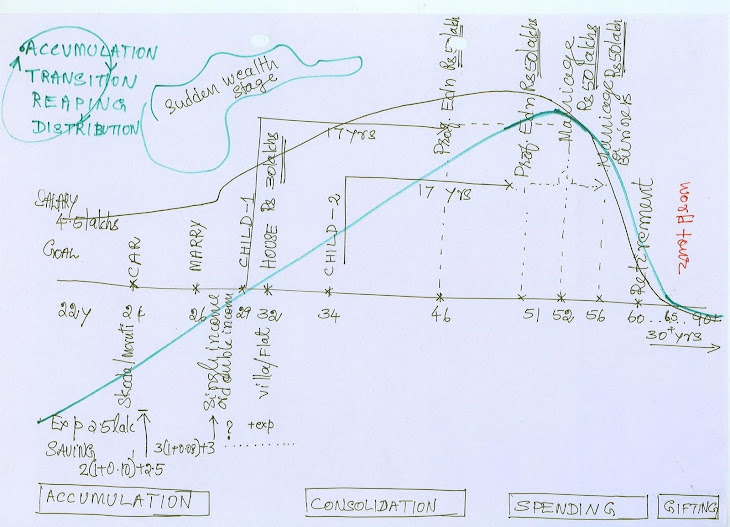
2. Savings : For saving a sum of money at a later point in life for acquiring an asset or meeting a life need is something, human race did from time immemorial. The earliest versions ofcourse being grains and gold stored for sale.
In our days, we have Recurring deposit accounts in Post office/banks, PPF, EPF, NSCs, RBI Relief Bonds, Treasury deposits, SIPs inMFs and Endowment Policies from Insurance companies to build up small savings over a period f time. Banks/Post offices give shorter maturities compared to MFs and Insurances. MFs can provide maximum maturities by their nature itself.
Depending upon your pocket size, the time frame of your plan for asset acquisition/life need matures , your risk apetite and the minimum amount required for acquiring the asset you can choose the asset class.
For risk taking individulas we have the equity route; With demat facilty and terminals across india, equity culture is catching up.
Once a certain amount is accumulated, it need to be converted into another asset for value harvesting and storage. This conversion time is very important in the case of highly risky equities and equity mutual funds.
Still another important lesson is about the usance period. The time required for normally moving an asset into cash in your hand. Another fact is how much time it will take for you to replace the revenue stream. This brings us to the conclusion that one needs liquid cash to meet daily routine expenses, then near cash assets and lines of ready cash supply to meet the planned expenses as well as the surprises.
3. Emergency Fund
Normally it is said that one has to maintain an amount equivalent to 3 months salary or normal income as an emergency fund. This could be augmented by credit card Or a gold loan.
Gold loan means you have acquired it earlier. It is asset backed. If you are not able to repay, you lose that one only.
The credit card is liability product. So it cannot be first line of defence. if you remit the minimum amout due only, the loan may be outstanding for next 6 years!!!
So it is always better to save and store for Emergencies. Celebrate Life, without surprises in expenses!!
Start Early, Proceed Systematically, Look Long Term
Let Your Money Work For You

All You Wanted to know about money
Showing posts with label Savings Plan. Show all posts
Showing posts with label Savings Plan. Show all posts
Thursday, February 4, 2010


Sunday, January 10, 2010
Protection Planning
How do one go about Protection planning?
I tried to look at the websites of several Insurance comopanies providing Protection Solutions and found out that every one is giving a window for punching the age and Sum Assured so that I know how much premium I have to pay. But how do I figure out the magical number of that Sum Assured?
First let me take you to Life Insurance :
My search ended up in creating this message board for you. There are 3 prominent ways in which Sum Assured can be calculated.
1. The traditional Rule of Thumb/Income Replacement method
According to this method, one takes a Sum Assured as certain multiple of current annual income.
If your annual income is Rs 15 lakhs, you take 6-8 times of that as Sum Assured. A variationof this is to change the multiple As & When you change life stages. Try this:
Life Stage in Age(yrs) - Summ Assured
20-30 years - 5-10 times Current annual Income
30-40 years - 15-20 ''
40-50 years - 10-15 ''
50-60 years - 5-10 times ''
2. Human Life Value(HLV)
HLV is defined as the present value of all future income that you could expect to earn for your family's benefit. It also includes other value you expect to contribute, less personal expenses, life insurance premiums and taxes through your planned retirement date
•Raja is 40 years old and plans to retire at 60. His current salary is Rs 3 lakhs and is expected to remain same every year. His personal expenses, life insurance premiums that he pays and taxes are around Rs 1.25 lakhs. His contribution to his family is rest of his salary of around Rs 1.75 lakhs.
•Gross Total Income: Rs 3 lakhs
•Less Self - Maintenance Charges: Rs 1 lakh
•Tax Payable: Rs 10,000
•Life Insurance Premium: Rs 15,000
•Surplus Income Generated for Family: Rs1.75 lakhs
•If this surplus income is capitalised at a discount rate (expected return rate) of 7 per cent per annum for 20 years, then the HLV will be = Rs 175,000*10.6 = Rs 18.55 lakhs.
3. The Need Based approach
1. Lump sum needs on Life to be Insured's death
You will items like
a. Home loan payoff
b. Car loan payoff
c. Child's education
d. Child's marriage
e. Emergency fund post death etc..
2. Monthly income needs
try to assess
a. Monthly expenses
b. Income of Living spouse in case she earns, or rent or interest
c. Shortfall = (a-b)
d. Monthly income needs till child turns 21 or is self-sufficient:
e. Number of years to go: For the child to reach 21 and post that for the spouse till her age of 80 or 90 years
f. Annual income needs: Of spouse, children or dependents
g. Total income needs: Of spouse, children or dependents
3. Sum up the current invested assets and current life insurance cover.
Now see how much (3) total differs by what you have calculated above (1) and (2). This will be the shortfall (considering that you die today) that you will need to get covered. But do note that invested assets exclude residence, car and other personal assets
Today most of the Financial Planners advice either the second or third one. The Salaried class may like to go by HLV when the Business Class prefer the third one as the income fluctuate more in the case of the latter.
You can avail Tax exemption under Sec 80 C of IT Act 1961 on premium paid on the policy in your name/spouse/children subject to overall limit of Rs 100000 and the individual limit of 20% on Sum Assured per policy.
The monies received by the nominee are not treated as income for tax purposes. This makes it convenient for Estate Planning.
Now let us look at Health Insurance:
National Programm on Women & Aging, USA prescribes less than 20% of disposable income after all other bills are paid as an indicative premium for an income bracket of $200000- $1.5million. GOI has not given any such directive so far.
But you get exemption under Sec 80 D. This may be a guiding post for you to start:
Union Budget 2008-09 has expanded the scope of this section by increasing the limit. Now, a person can get an additional benefit of Rs 15,000 for self, spouse, children and dependent parents. Thus, a total tax relief of Rs 30,000 is now possible now. Also, if any of the two parents are above the age of 65 years, the deduction goes up to Rs 20,000. It is not necessary that the parents should be dependent on the taxpayer. It is important to remember though that the payments for the policies should be made by cheques and not in cash or by credit card.
What about Property Insurance:
You will obviously buy Vehicle Insurance because the laws are stringent. what about other asssets? the moment you posses an asset, there is a risk attached to it. How much of it you want to protect is left to the risk disposition of the owner.
Detailed assessment procedures are available with the Insurance companies.
Next step is to study the offer from the Insurance Provider as to hidden charges and premiums for same Sum Assured.
I tried to look at the websites of several Insurance comopanies providing Protection Solutions and found out that every one is giving a window for punching the age and Sum Assured so that I know how much premium I have to pay. But how do I figure out the magical number of that Sum Assured?
First let me take you to Life Insurance :
My search ended up in creating this message board for you. There are 3 prominent ways in which Sum Assured can be calculated.
1. The traditional Rule of Thumb/Income Replacement method
According to this method, one takes a Sum Assured as certain multiple of current annual income.
If your annual income is Rs 15 lakhs, you take 6-8 times of that as Sum Assured. A variationof this is to change the multiple As & When you change life stages. Try this:
Life Stage in Age(yrs) - Summ Assured
20-30 years - 5-10 times Current annual Income
30-40 years - 15-20 ''
40-50 years - 10-15 ''
50-60 years - 5-10 times ''
2. Human Life Value(HLV)
HLV is defined as the present value of all future income that you could expect to earn for your family's benefit. It also includes other value you expect to contribute, less personal expenses, life insurance premiums and taxes through your planned retirement date
•Raja is 40 years old and plans to retire at 60. His current salary is Rs 3 lakhs and is expected to remain same every year. His personal expenses, life insurance premiums that he pays and taxes are around Rs 1.25 lakhs. His contribution to his family is rest of his salary of around Rs 1.75 lakhs.
•Gross Total Income: Rs 3 lakhs
•Less Self - Maintenance Charges: Rs 1 lakh
•Tax Payable: Rs 10,000
•Life Insurance Premium: Rs 15,000
•Surplus Income Generated for Family: Rs1.75 lakhs
•If this surplus income is capitalised at a discount rate (expected return rate) of 7 per cent per annum for 20 years, then the HLV will be = Rs 175,000*10.6 = Rs 18.55 lakhs.
3. The Need Based approach
1. Lump sum needs on Life to be Insured's death
You will items like
a. Home loan payoff
b. Car loan payoff
c. Child's education
d. Child's marriage
e. Emergency fund post death etc..
2. Monthly income needs
try to assess
a. Monthly expenses
b. Income of Living spouse in case she earns, or rent or interest
c. Shortfall = (a-b)
d. Monthly income needs till child turns 21 or is self-sufficient:
e. Number of years to go: For the child to reach 21 and post that for the spouse till her age of 80 or 90 years
f. Annual income needs: Of spouse, children or dependents
g. Total income needs: Of spouse, children or dependents
3. Sum up the current invested assets and current life insurance cover.
Now see how much (3) total differs by what you have calculated above (1) and (2). This will be the shortfall (considering that you die today) that you will need to get covered. But do note that invested assets exclude residence, car and other personal assets
Today most of the Financial Planners advice either the second or third one. The Salaried class may like to go by HLV when the Business Class prefer the third one as the income fluctuate more in the case of the latter.
You can avail Tax exemption under Sec 80 C of IT Act 1961 on premium paid on the policy in your name/spouse/children subject to overall limit of Rs 100000 and the individual limit of 20% on Sum Assured per policy.
The monies received by the nominee are not treated as income for tax purposes. This makes it convenient for Estate Planning.
Now let us look at Health Insurance:
National Programm on Women & Aging, USA prescribes less than 20% of disposable income after all other bills are paid as an indicative premium for an income bracket of $200000- $1.5million. GOI has not given any such directive so far.
But you get exemption under Sec 80 D. This may be a guiding post for you to start:
Union Budget 2008-09 has expanded the scope of this section by increasing the limit. Now, a person can get an additional benefit of Rs 15,000 for self, spouse, children and dependent parents. Thus, a total tax relief of Rs 30,000 is now possible now. Also, if any of the two parents are above the age of 65 years, the deduction goes up to Rs 20,000. It is not necessary that the parents should be dependent on the taxpayer. It is important to remember though that the payments for the policies should be made by cheques and not in cash or by credit card.
What about Property Insurance:
You will obviously buy Vehicle Insurance because the laws are stringent. what about other asssets? the moment you posses an asset, there is a risk attached to it. How much of it you want to protect is left to the risk disposition of the owner.
Detailed assessment procedures are available with the Insurance companies.
Next step is to study the offer from the Insurance Provider as to hidden charges and premiums for same Sum Assured.
Subscribe to:
Posts (Atom)